- Published on
Backend for Frontend (BFF) Architecture: Understanding and Applying It Effectively
- Authors

- Name
- Khoa (Atlas Labs)
- Occupation
- Full-stack developer
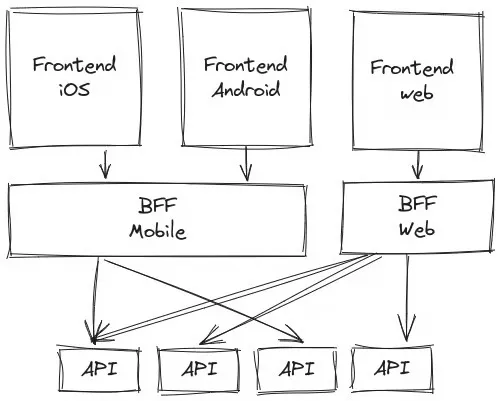
Backend for Frontend (BFF) Architecture: Understanding and Applying It Effectively
1. What is BFF and Why Do We Need It?
What is Backend for Frontend (BFF)?
BFF is a modern architectural pattern in which each user interface (frontend) has its own separate backend layer. Instead of using a single common API for all platforms like web, mobile, or IoT, BFF allows customizing the backend to meet the specific needs of each frontend.
Why Do We Need BFF?
In the era of multi-platform applications and the rise of microservices, frontends such as mobile apps, web apps, and smart devices require different data and performance levels. BFF helps optimize data and performance, delivering the best user experience.
Benefits of BFF:
- Data optimization for each platform.
- Reduced complexity in communication between frontend and backend.
- Increased performance and security.
2. How BFF Works
Basic BFF Flow
- Request from frontend: Applications such as web or mobile send requests to the BFF.
- Processing at the BFF layer: BFF collects data from multiple microservices, handles specific logic, and normalizes data.
- Response: Returns optimized data to the frontend.
BFF's Role in the Architecture
- Data orchestration: Combines information from multiple microservices.
- Data customization: Prepares data in the correct format and suitable for frontend needs.
- Logic processing: Executes logic specific to the user interface.
3. Differences Between Traditional Architecture and BFF
Traditional Architecture
In traditional architecture, a single API handles all requests from all frontends. This leads to:
- Over-fetching: Applications receive more data than necessary.
- Under-fetching: Multiple requests must be made to get enough data.
- Suboptimal performance: Doesn't perform well on mobile networks or resource-constrained devices.
BFF Architecture
BFF overcomes these disadvantages by creating separate backends for each frontend, which helps:
- Optimize data and performance.
- Simplify the development process.
- Enhance the user experience.
4. Advantages of BFF in Modern Architecture
1. Customized User Experience
Each frontend receives exactly the data it needs, without over-fetching or under-fetching information.
2. Reduced Complexity
Separating backends for each platform makes them easier to manage and maintain.
3. Superior Performance
By optimizing API calls and processing data locally, BFF reduces latency, delivering fast responses.
4. Flexible Development
Development teams can work independently on each BFF, accelerating project timelines.
5. Strong Security
BFF controls all interactions with the backend, allowing strict security measures such as token authentication and rate limiting.
5. When Should You Use BFF?
Multi-Platform Applications
When building applications that operate on multiple platforms such as web, mobile, or IoT, BFF gives each platform its own optimized backend.
Data Orchestration from Microservices
BFF acts as a "middleware", fetching data from multiple microservices and returning a unified response to the frontend.
Optimizing Legacy APIs
When migrating from an old system to a microservices architecture, BFF helps hide the complexity of the old backend and provides a modern interface for the frontend.
6. Challenges and How to Overcome Them
Challenges
- Maintenance cost: Need to manage multiple separate backends.
- Data consistency: Inconsistencies can arise between backends.
- Performance: The BFF layer can become a bottleneck if not optimized.
Solutions
- Limit business logic in BFF: Focus on data formatting and orchestration.
- Use caching: Cache common responses to reduce load.
- Strengthen security: Token authentication, rate limiting, and error logging.
7. Success Stories with BFF
Netflix
Netflix uses BFF to optimize data for each platform. For example, the mobile app only receives lightweight data, while the desktop application fetches more detailed information.
Spotify
Spotify deployed BFF to ensure each device, from phones to smart speakers, receives optimized data, providing a smooth experience.
8. Conclusion
Backend for Frontend (BFF) is an optimal solution for modern application architecture. By providing customized backends for each frontend, BFF helps enhance the user experience, increase performance, and simplify development. Although it may face some challenges, the benefits that BFF brings are worth the investment. Try implementing BFF in your next project to see the difference!